In addition to normal types of chromosomes special type of chromosomes with different structure, shape, size and function have been found in varied groups of animals and plants.
These are very useful in cytogenetic studies. The most important are gaint chromosomes and super numerary chromosomes.
Gaint chromosomes
– These are exceptionally larger chromosomes.
– They are two types of gaint chromosomes, namely polytene chromosomes and lamp brush chromosomes.
1. Polytene chromosome
– Polytene chromosomes have following salient features,
I. It was discovered by balbiani in 1881.
II. It is found in salivary gland cells of chironomus larva. Hence it is also called as salivary gland chromosome.
III. It is a gaint chromosome. it is larger in size. For eg- In drosophila melanogaster it is 1000 times larger than somatic chromosomes.
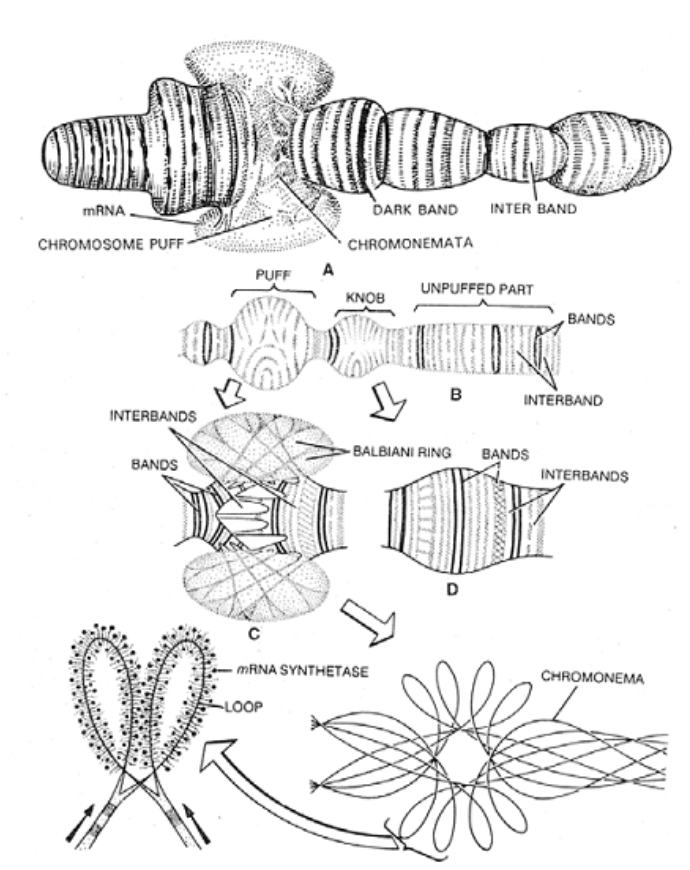
IV. The larger size of chromosomes is due to presence of many longitudinal strands called Chromonemata.
V. The polytene chromosomes contai two types of transverse bands, namely dark bands and inter bands.
VI. The dark bands are darkly stained and inter bands are lightly stained with nuclear stains.
VII. The Dark bands contain more DNA and less RNA. The inter bands contain more RNA and less DNA.
VIII. The bands of polytene chromosomes become enlarged certain times to form swelling called puffs (or) balbiani rings.
IX. The formation of puffs is called puffing.
X. This puffs indicate the site of active genes when mRNA synthesis occurs.
2. Lamp brush chromosomes
– The lamp brush Chromosomes has following features.
I. It was discovered by Ruckert in 1892.
II. It contains lateral loops and appears like brush. Hence the name lamp brush Chromosome.
III. It is found in Oocytes of Sagitta Sepia, Echinaster, Insects, Sharks, Amphibians, Reptiles and Birds.
V. It is a gaint chromosomes. It is larger in size.
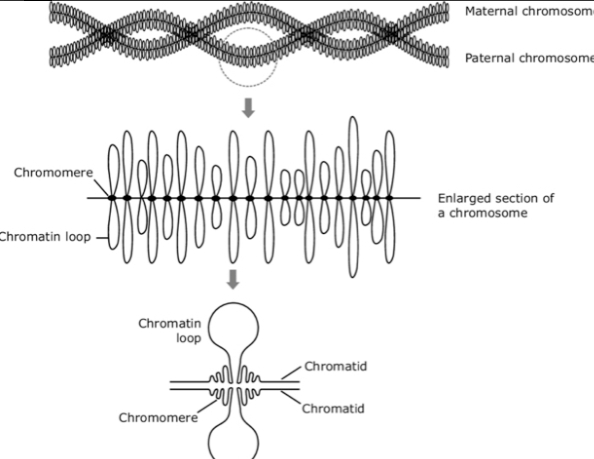
VI. Each lamp brush Chromosomes consists of main axis and many lateral loops.
VII. The main axis of each chromosome is formed of 4 chromatin.
VIII. The main axis contains a series of thickening called chromomere and on each side of chromosome a pair of lateral loops are formed.
IX. Each loop has axial fibre which is surrounded by matrix. It is formed of RNA and proteins. The matrix gives a fuzzy appearance.
X. The axial fibre is continuation of chromonemia of main axis. Hence it contain DNA.
Thank you for visiting
 wikipedia in brief