MITOSIS

– In mitosis, Nucleus and chromosomes both divide only once and thus the same chromosome number is maintained in new cells.

– Thus mitosis involves the division of nucleus which results in daughter nuclei with same genetic constitution as that of parent nucleus.

– Mitosis is found in somatic cells in both plants and animals. Mitosis can be divided into five phases:-

1. Prophase

– It is longest mitotic stage each chromosome is made up of two chromatids.

– In early stage of prophase both the chromatids of each chromosome are coiled about each other relationally they can’t be easily separated ( i.e, they are actually twisted together ).

– The nucleolus disappears at end of prophase and the nuclear envelope is also broken down, which disappears into cytoplasm as elements of endoplasmic reticulum.

2. Metakinesis ( pro-metaphase )

– It is the stage which occurs before metaphase.

– In this stage Chromosomes move towards the central region of cell.

– In both plant and animal cell, regardless of its origin, the spindle fibre apparatus is seen.

– The movement of chromosomes towards center of cell and their axis of orientation are governed partly by fibres.

– The spindle fibre attaches to a centromere of chromosome.

3. Metaphase

– At this stage the spindle is fully developed, the chromosomes are arranged at equatorial plane and the nuclear envelope and nucleoli are fully disappeared.

– They could lie in equatorial plane of cell, centromeres divide and each chromatid, now a single chromosome, moves to align itself on equatorial plate of metaphase.

4. Anaphase

– It is the shortest of all stages in mitotic cycle.

– This begins when the chromatid of ech chromosome start moving a part in opposite directions.

– In this way the chromatids are now identically divided between two poles and Chromosome number remains constant.

5. Telophase

– When the chromatids have reached the opposite poles, they form a close group at each poles.

– The chromatids at each pole are now known as daughter chromosomes.

– During this phase Nuclear membrane and nucleoli re-appear and surround the chromosomes.

– The daughter Chromosomes loosen their coils and lose their stain ability.

– Each chromatid gives rise to Two Chromonemata attached subterminally by centromere and thus ultimately the chromatids go back to prophase condition and form the reticulum.

Cytokinesis

– The process in animal cell usually begins at about the late Anaphase (or) early Telophase.

– During this phase the division of cytoplasm appears.

Phases of the cell cycle: diagram of chromosomes ( DNA ), organelles, mitotic spindle in each stage of cell division.

Thank you for visiting

Structure of DNA

DNA is a polymer of deoxy-ribonucleotides. It is composed of monomeric units namely deoxyadenylate ( DAMP ), deoxyguanylate ( DGMP ), deoxycytidylate ( DCMP ), and deoxythymidylate ( DTMP ).

SYSTEMATIC REPRESENTATION OF POlYNUCLEOTIDES :-

– The Monomeric deoxy nucleotides in DNA are held together by 3′, 5′- phosphodiestes bridges.

– DNA structure is often represented in a short hand form.

– The horizontal line indicates the carbon chain of sugar with base attached to C1. Near the middle of the horizontal line C3 1 phosphate linkage while at the other end of the line is C5 phosphate linkage.

DNA Double Helix

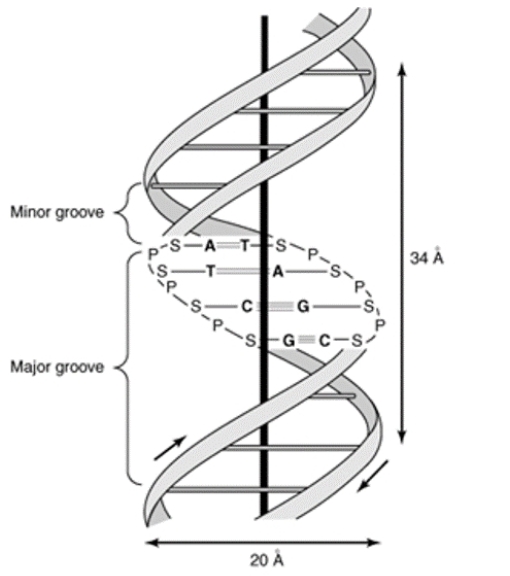
– The double helical structure of DNA was proposed by James Waston and Francis Crick in 1953.

– The structure of DNA Double Helix is composed to a twisted ladder.

Waston-Crick model of DNA Helix

Salient Features Of Waston-Crick Model Of DNA :-

1. The DNA is a right handed double helix. It connect of two polydeoxy ribonucleotide chains twisted around each other on a common axis.

2. The two strands are anti parallel i.e, one strand in the 5′ to 3′ direction while the other is 3′ to 5′ direction.

3. The width of a double helix is 20A° ( 2nm ).

4. Each turn of the helix is 34A° ( 3.4 nm ) with 10 pairs of nucleotides each pair Placed at a distance of about 3.4A°.

5. The two polynucleotide chains are not identical but complementary to each other due to base pairing.

6. The two strands are held together by hydrogen bonds formed by complementary base pairs.

7. The hydrogen bonds are formed between a purine and a pyrimidene only.

8. The only base arrangement possible in DNA structure from special consideration is A-T, T- A, G-C, & C-G.

9. The complementary base pairing in DNA helix proves chargaff’s rule. The content of adenine equals to that of thymine ( A=T ) and guanine equals to that of cytosine ( G=C ).

10. The genetic information resides on one of the two strands known as template strand (or) sense strand. The opposite strand is antesence strand.

11. The double helix has ( wide ) major groove and ( narrow ) minor groove along the phospho di ester back bone proteins interact with DNA at these grooves without dicrupting the base pairs and double helix.

Thank you for visiting

Chromosomes Types

In addition to normal types of chromosomes special type of chromosomes with different structure, shape, size and function have been found in varied groups of animals and plants.

These are very useful in cytogenetic studies. The most important are gaint chromosomes and super numerary chromosomes.

Gaint chromosomes

– These are exceptionally larger chromosomes.

– They are two types of gaint chromosomes, namely polytene chromosomes and lamp brush chromosomes.

1. Polytene chromosome

– Polytene chromosomes have following salient features,

I. It was discovered by balbiani in 1881.

II. It is found in salivary gland cells of chironomus larva. Hence it is also called as salivary gland chromosome.

III. It is a gaint chromosome. it is larger in size. For eg- In drosophila melanogaster it is 1000 times larger than somatic chromosomes.

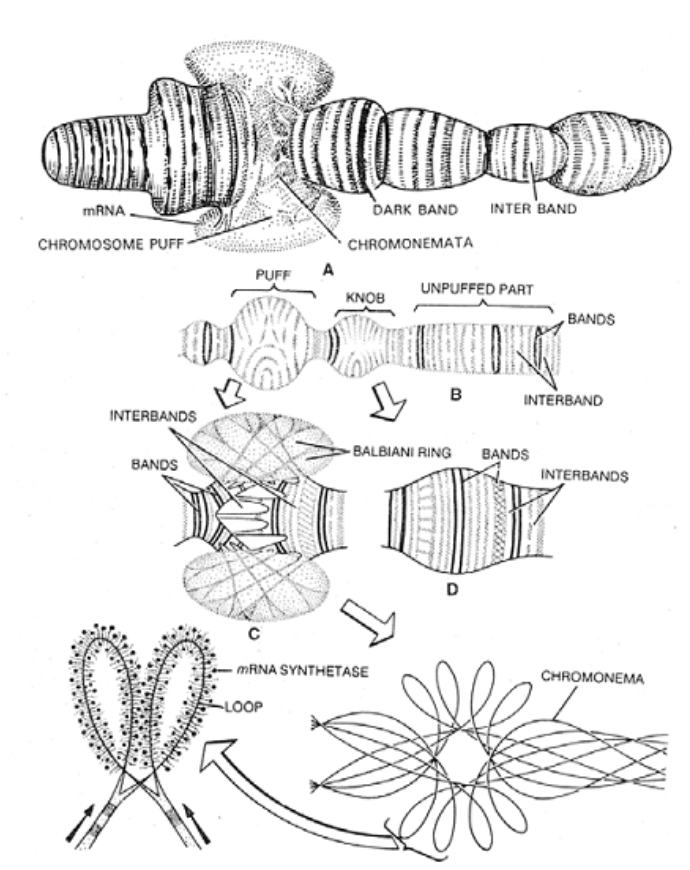
IV. The larger size of chromosomes is due to presence of many longitudinal strands called Chromonemata.

V. The polytene chromosomes contai two types of transverse bands, namely dark bands and inter bands.

VI. The dark bands are darkly stained and inter bands are lightly stained with nuclear stains.

VII. The Dark bands contain more DNA and less RNA. The inter bands contain more RNA and less DNA.

VIII. The bands of polytene chromosomes become enlarged certain times to form swelling called puffs (or) balbiani rings.

IX. The formation of puffs is called puffing.

X. This puffs indicate the site of active genes when mRNA synthesis occurs.

Polytene chromosome diagram

2. Lamp brush chromosomes

– The lamp brush Chromosomes has following features.

I. It was discovered by Ruckert in 1892.

II. It contains lateral loops and appears like brush. Hence the name lamp brush Chromosome.

III. It is found in Oocytes of Sagitta Sepia, Echinaster, Insects, Sharks, Amphibians, Reptiles and Birds.

V. It is a gaint chromosomes. It is larger in size.

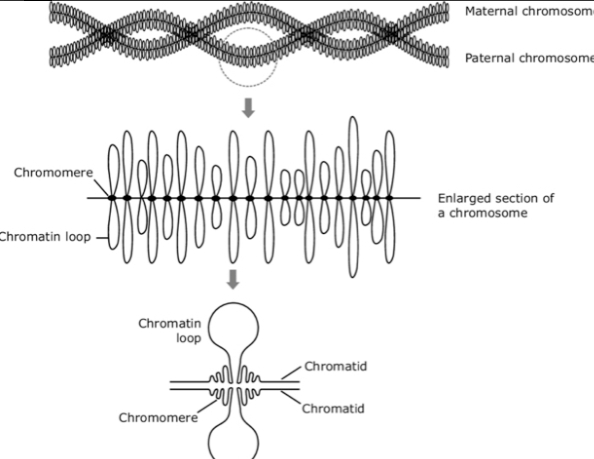
VI. Each lamp brush Chromosomes consists of main axis and many lateral loops.

VII. The main axis of each chromosome is formed of 4 chromatin.

VIII. The main axis contains a series of thickening called chromomere and on each side of chromosome a pair of lateral loops are formed.

IX. Each loop has axial fibre which is surrounded by matrix. It is formed of RNA and proteins. The matrix gives a fuzzy appearance.

X. The axial fibre is continuation of chromonemia of main axis. Hence it contain DNA.

Lamp brush chromosome diagram

Thank you for visiting

Eukaryotic cell ( Definition, structure, features with labelled diagram)

Definition

The cell of all living organisms except various Bacteria & certain algae have definite nucleus in the cytoplasm which always covered by a membrane known as nuclear membrane. All such cells are called as a eukaryotic cells.

The eukaryotic cells are larger than prokaryotic cells. It ranges from 10-100πm. These are true cells occur in animals.

Structure

1. Generally the shape or the structure of eukaryotic cell are round and spherical.

2. It may be variable( i.e, frequently changing the shape ) as in amoeba (or) fixed almost in all plants and animals.

3. In fixed cell types, some other shape have also been observed. These are the shapes of oval cuboidal, cylindrical, flat, elongated & spindle shape.

4. The shape of cell depends mainly on functional adaptations & partly on the surface tension of & viscosity of protoplasm.

5. The eukaryotic cells are essentially two envelop system.

6. The secondary membrane envelop the nucleus and other internal organelles.

7. The shape, size and physiology may vary in different eukaryotic cells.

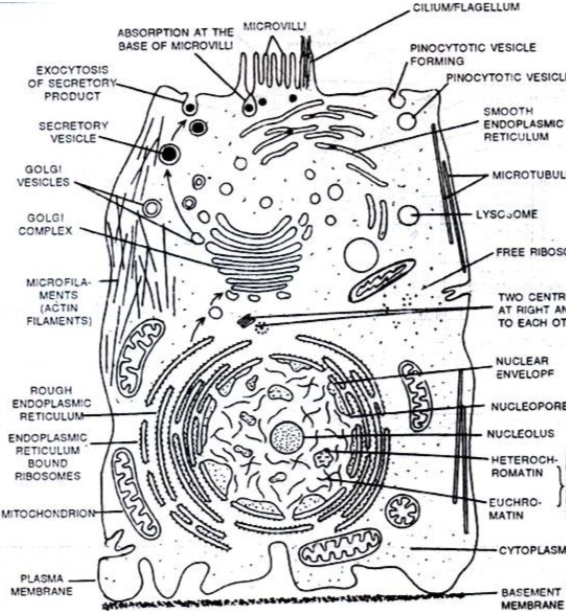
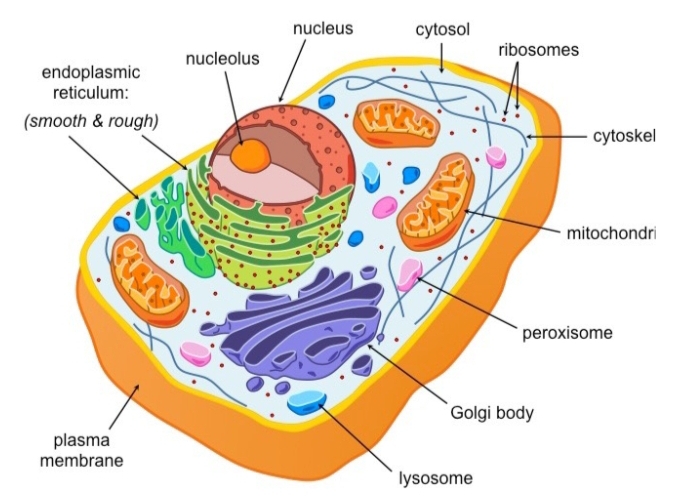
Ultrastructure of generalized animal eukaryotic cell

Features

– Nuclear envelop is present in eukaryotic cell.

– DNA is combined with proteins.

– Chromosomes are present in multiple and ribosomes are 80’s ( 60’s & 40’s ).

– Cell division is occurs through both the mitosis and meiosis.

– Locomotion is carried out through the cilia in flagella.

– All eukaryotic cells are composed of plasma membrane, cytoplasm, endo membrane, mitochondria, lysosomes, centrosomes etc., And a true nucleus.

– The eukaryotic cells may be following types,

Epithelial cells, Macrophages, Nerve cells, Bone cells, Brain cells, Ciliated cells, Flagellated cells of connective tissue, Muscle cells, Blood cells, Adipose cells.

Eukaryotic Typical structure of animal cell

Thank you for visiting….